I’ve been collecting tech facts for years and most of them are boring.
You know the ones. The same recycled trivia about how many Google searches happen per second or how much data Facebook stores. You’ve seen them a thousand times.
Tech geeks like us want the real stuff. The facts that make you stop and think “wait, seriously?”
I dug through old developer logs, patent filings, and archived interviews to find tech facts that are actually worth remembering. Every single one is verified. No myths. No half-truths.
This article is what I wish existed when I first got obsessed with technology. Facts that give you a deeper look at how the digital world actually works.
You’ll walk away with conversation starters that don’t make people’s eyes glaze over. The kind of stuff that makes other tech geeks lean in and ask “how did you know that?”
No fluff. No basic trivia you can find anywhere else.
Just the facts that made me fall in love with technology all over again.
The Internet’s Secret History: Facts from Before the Dot-Com Boom
Ever wonder what the internet looked like before cat videos and social media?
I’m talking about the wild west days. When the whole thing was just a bunch of universities sharing research papers.
The stories from that era? They’re stranger than you’d think.
The First ‘Spam’ Email
In 1978, a guy named Gary Thuerk sent an email to 400 ARPANET users. He wanted to sell them a new DEC computer model.
People lost their minds.
Not because they wanted the computer. Because he’d just cluttered their inboxes with something they didn’t ask for.
The Defense Communications Agency (which ran ARPANET) told him to knock it off. But the damage was done. Spam was born.
The Real Reason for the ‘@’ Symbol
Why do we use @ in email addresses?
Ray Tomlinson needed a separator in 1971. Something that wouldn’t show up in anyone’s name. The @ symbol was just sitting there on his keyboard, doing nothing.
That’s it. No grand vision. No design philosophy.
Just a programmer making a logical choice that stuck around for 50 years.
The World’s First Webcam Had a Very Specific Job
Cambridge University researchers had a problem in 1991.
They kept walking to the break room only to find an empty coffee pot. So they pointed a camera at it and wrote some code to check the pot from their desks.
The Trojan Room coffee pot became the first thing ever streamed on the web. Not a concert. Not a sports game. Coffee.
(Honestly? Still the most relatable use of technology I’ve ever seen.)
The Heaviest ‘Website’
Here’s a weird one. In 2019, the Beresheet lunar lander carried something called the Lunar Library to the moon. Microfilm discs containing 30 million pages of data, including a snapshot of Wikipedia and other web content.
The whole thing weighed about 40 grams.
Think about that. You can hold a physical copy of a chunk of the internet in your hand.
Want more stories like these? Check out dtrgstechfacts for the tech history nobody talks about.
Hardware Marvels: The Physical Tech That Changed Everything
I still remember the first time I held a 1TB external drive.
It fit in my palm. Weighed maybe four ounces.
My dad looked at it and shook his head. He told me about the first hard drives he worked with in the early 80s. You couldn’t hold those. You could barely move them without help.
That moment stuck with me. Because it made me realize how wild hardware evolution really is.
The Mouse’s Humble Beginnings
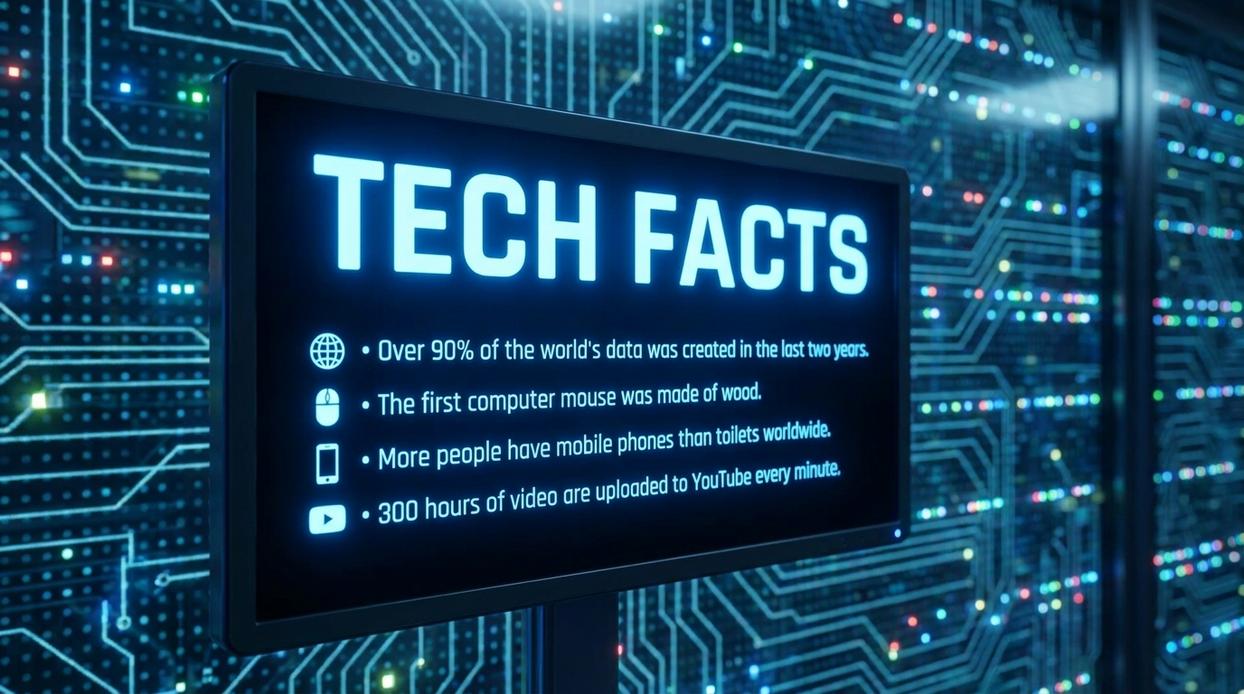
Douglas Engelbart built the first computer mouse in 1964. It was a carved wooden block with a single button and two metal wheels underneath.
That’s it. No ergonomic curves. No wireless tech. Just wood and metal.
He called it a mouse because the cord looked like a tail. (Sometimes the simplest explanations are the right ones.)
The First Gigabyte Hard Drive Weighed 550 Pounds
The IBM 3380 launched in 1980. It stored 2.52 GB of data.
It was the size of a refrigerator and cost $40,000.
| Spec | IBM 3380 (1980) | Modern 2TB Drive |
|———-|———————|———————-|
| Weight | 550 lbs | 4 oz |
| Size | Refrigerator | Palm-sized |
| Storage | 2.52 GB | 2,000 GB |
| Cost | $40,000 | $60 |
You needed a forklift to install one. Now we carry thousands of times more storage in our pockets.
Your Smartphone vs. Apollo 11
The Apollo Guidance Computer had 64 KB of memory and ran at 0.043 MHz.
Your smartphone? It has about 4 GB of RAM and runs at roughly 2,500 MHz.
That’s not just better. It’s millions of times more processing power. The device you use to scroll through videos could have run the entire Apollo program and still had room left over.
We went to the moon with less computing power than a modern calculator watch.
The Sound of a Dial-Up Modem Explained
Those beeps and squawks weren’t random noise.
They were two modems talking to each other. The first series of tones was one modem saying hello. The responding chirps were the other modem answering back. Then came the negotiation phase where they figured out the fastest stable connection speed they could both handle.
It was a digital handshake that happened in real time. You could literally hear your computer making a deal with another computer across town.
I miss that sound sometimes. It made the internet feel like something you had to work for.
The tech geeks dtrgstechfacts community knows this stuff matters. Not because it’s nostalgic. But because understanding where we came from helps us see where we’re going.
Hardware didn’t just get smaller and faster. It got accessible. That wooden mouse led to touchscreens. That refrigerator-sized drive led to cloud storage.
Every marvel started as something clunky and expensive that most people couldn’t imagine using.
Now look around.
Software Secrets & Surprising Code
You know that feeling when you find something weird in your code and you’re not sure if it’s a feature or a mistake?
Back in 1947, Grace Hopper had that exact moment. Except she found an actual moth stuck inside the Harvard Mark II computer.
She taped it into the logbook. Wrote “First actual case of bug being found” next to it. The relay had failed because this tiny insect got trapped in the mechanical switches, and you could probably hear the faint click-click-click of those relays going haywire before they found it.
That’s where we got the term “bug.”
Fast forward to 1971. A guy creates the first commercial video game called Computer Space. Picture this clunky cabinet sitting in a bar, glowing screens reflecting off beer bottles. The game flopped hard because people found it too confusing.
But it taught the industry something. Keep it simple. That’s why Pong came next and actually worked.
Then there’s Y2K. Remember that panic?
Programmers back in the day used two digits for years to save memory (because storage was expensive). So 1999 became 99. But when 2000 hit, systems would read it as 1900. Chaos.
We spent around $300 billion globally to fix it. Tech geeks dtrgstechfacts like this one show how a tiny shortcut can snowball.
Here’s my favorite though.
That Windows 95 startup sound? The one that made you feel like you were booting into the future? Brian Eno composed it. On a Mac.
Microsoft gave him 150 adjectives as inspiration:
- Inspiring
- Optimistic
- Futuristic
- Emotional
Six seconds. That’s all he had to work with. And somehow he nailed it.
Mind-Bending Modern Tech Stats
You probably think you understand how much data exists online.
You don’t.
None of us really do. The numbers are so big they stop making sense.
Let me show you what I mean.
The digital universe now measures in zettabytes. A zettabyte is a billion terabytes. Still doesn’t click, right?
Here’s a better way to picture it. If each gigabyte were a single brick, one zettabyte would build over 250 Great Walls of China.
That’s not a typo.
And we’re creating more every second.
YouTube’s Upload Problem
Right now, while you’re reading this, people are uploading over 500 hours of video to YouTube. Every single minute.
That means YouTube needs to store more content in one hour than you could watch in several lifetimes.
The servers required to handle that? They fill warehouses the size of football fields.
What Your Like Actually Costs
You tap the heart icon on a post. Takes half a second.
But here’s what happens behind that simple action. Your phone sends a signal to a server. That server processes your request, updates a database, notifies the original poster, and refreshes feeds for potentially thousands of other users.
Multiply that by billions of interactions per day. The energy cost adds up fast. Some estimates put a single data center’s power consumption equal to a small city.
For tech geeks dtrgstechfacts like this one matter because they show the real infrastructure behind our digital habits.
GPS and Einstein’s Theory
Your phone’s GPS works because of Einstein.
Seriously.
GPS satellites orbit Earth at high speeds. According to relativity, their clocks run slightly faster than ours down here. We’re talking microseconds.
But those microseconds matter. If engineers didn’t correct for this time difference, your GPS would be off by several miles each day.
You’d end up in someone’s backyard instead of the coffee shop.
Want to learn more about how tech actually works behind the scenes? Check out online selling techniques dtrgstechfacts for deeper dives into digital systems.
The point is simple. Every tap, swipe, and search you make involves more processing power and physics than most people realize.
And it’s only getting bigger.
Stay Curious in a World Built on Code
You came here to learn something new about tech.
Now you know the stories behind the code. The accidents that changed everything. The wild numbers that make our digital world possible.
Most people never look past their screens. They miss the ingenuity and weird coincidences that built the internet we can’t live without.
But you’re different.
You asked why and you got answers. That’s how you understand tech on a deeper level.
Here’s what I want you to do: Pick your favorite fact from this list and share it with another tech geek. Tell them to visit dtrgstechfacts for more stories like these.
The tech world keeps evolving. Your job is to stay curious and keep digging into the fascinating machinery behind your screen.
Don’t stop asking questions.
 Founder & Chief Technology Editor